
Dental Emergencies for Children
What to do for your littles ones when toothache or injury strikes
Dental emergencies are stressful enough for adults but can be especially scary for kids. Here we go into detail about the types of emergencies involving children we see at The Emergency Dentist Sydney and what to do to get through it.
What to do for your littles ones when toothache or injury strikes
Dental emergencies are stressful enough for adults but can be especially scary for kids. Here we go into detail about the types of emergencies involving children we see at The Emergency Dentist Sydney and what to do to get through it.
Toothache
A toothache can occur for many reasons from food being stuck, decay or even an abscess, which may look like a little pimple on your child’s gums. Whatever the reason, it is best to get in contact asap so that we can diagnose the cause and relieve their pain. Generally, toothaches don’t get better with time, they get worse.
While waiting to get into the dentist chair you may check the mouth for debris and rinse thoroughly or gently use dental floss. It is not recommended however, to apply ice directly to teeth or gums as the tissue is sensitive and could burn.
Abscess
An abscess is an infection that occurs in the root of the tooth and fills with puss when left untreated. Not only does it cause a lot of pain for your child but can also result in breathing difficulties, pain when eating, fever, sensitivity, toothache, facial and gum swelling.
Chipped or broken teeth
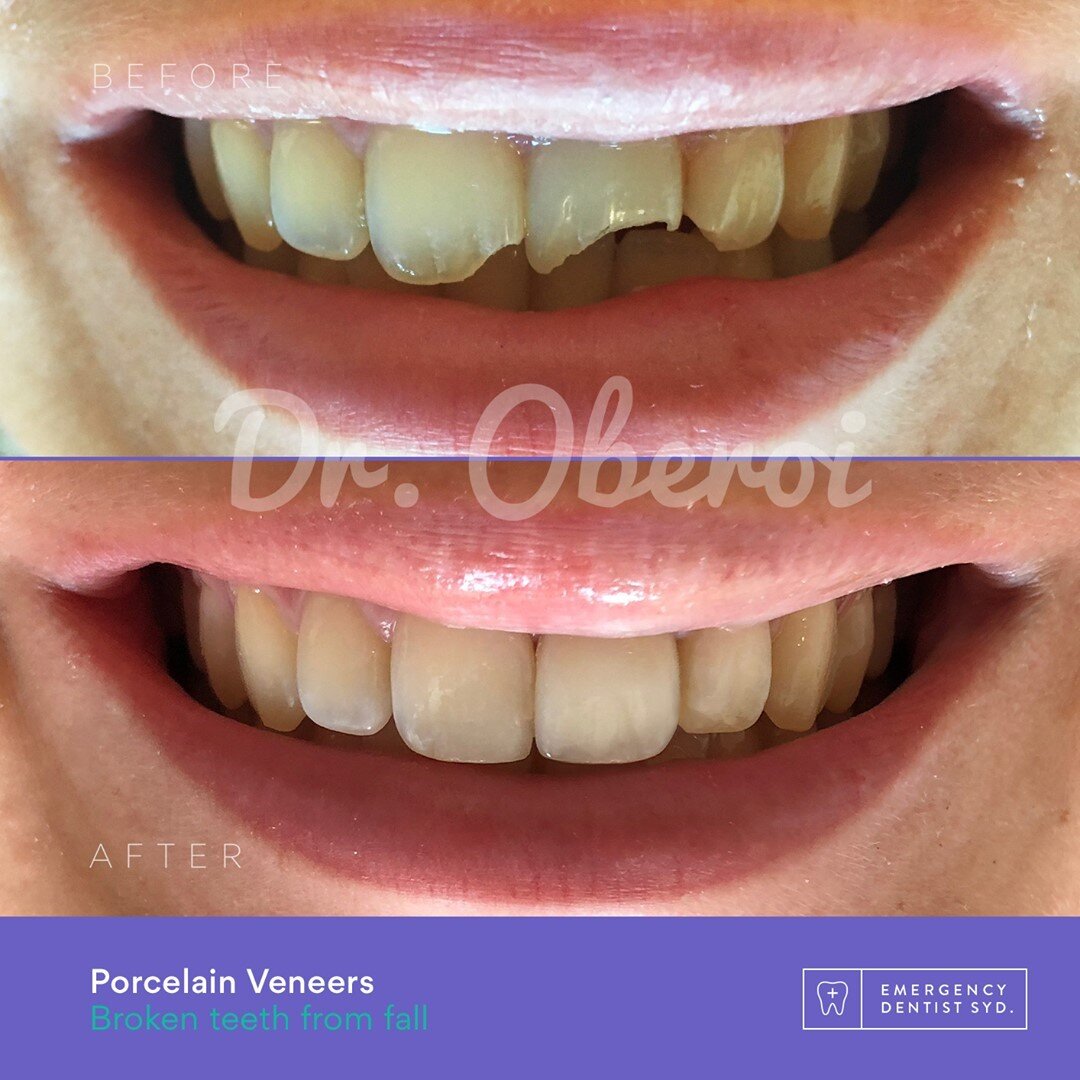
It’s a fact of life that kids are pretty active. Playing sport, running around with friends or chewing on things they shouldn’t, may result in a cracked, chipped or broken tooth. If this does happen, contact us immediately so we can evaluate the damage and provide solutions for fixing it.
Dislodged Fillings
If your child’s filling comes loose or falls out, this should be dealt with and replaced quickly as the inner part of the tooth becomes exposed to severe sensitivity or toothache and even tooth decay as bacteria can enter.
Objects in the mouth
No matter how many times you tell your child not to, from time to time they’re going to put things in their mouths that they shouldn’t. Sometimes these objects or parts of the object can become wedged in their teeth. It’s important not to apply a great deal of pressure in trying to remove lodged objects but just gently try with dental floss – if it’s still not budging, best to get them in to see us so we can remove it whilst minimising any other damaged, like broken teeth.
Most importantly, stay calm during your child’s dental emergency to minimise the fear and stress they’re likely to be experiencing. The team at The Emergency Dentist Sydney are very experienced in this area and will have your little one on the path to recovery and smiling again in no time.
Need Advice Or Emergency Dental Care In Sydney CBD?
Contact our friendly team


First Impressions Count
"...And Remember To Smile
And Remember To Smile
Nelson Mandela once famously said, “Appearances matter, and remember to smile”. As dentists we have adopted the latter part of that quote, #RememberToSmile. In context, Mandela was talking to Time Magazine about some important lessons he had learnt during his 90 years and we can see why.
Before an interview, a big presentation and certainly before a date or a night out you take great care to make sure your clothes are on point, your hair looks good and everything smells good. In fact, you no doubt spend more than a bit of time and money on these efforts to make the best possible first impression. But here's a question for you, how much did you spend on your smile?
“Appearances matter, and remember to smile”
You've heard the expression 'million-dollar smile' right? It's more than just a jaded saying though. Your smile has a far bigger impact on that great first impression than you might realise. According to a psychologist from the States, Dr Paul Ekman, professor of psychology at the University of California and a man known as 'Professor Smiles', as he has devoted his career to studying them, people respond to a great smile from up to 30 meters away. And a smile, he says, lets people they are likely to get a good reception, making it hard not to reciprocate. In other words a smile is a great way to set up a good interaction before you ever say a word, a real plus when you are on that big interview or first date.
That having been said a great smile is about a lot more than the ability to get those facial muscles into the right place. The focus is on the mouth when you smile, which means your teeth. A bright white smile and a set of healthy, well-cared for teeth and gums can say an awful lot about you, mainly that you take pride in your appearance and that your health is important to you. It is also a confidence booster for you, as people with teeth that are stained, cracked, discoloured or otherwise imperfect smile a lot less than people with 'good teeth', whether they realise it or not, and people who avoid smiling often come across as self-conscious, nervous or even rather rude.
The Keys to a Confident Smile

These 'smile problems' are far from unusual of course, lots of people have problems with more than just the colour of their teeth, their teeth might also be broken, cracked and/or crooked. And they may think there is not too much they can do about those latter problems other than keep their mouth closed as much as possible. However, that really isn't the case anymore. Modern dentistry has a 'fix' for pretty much all of them.
A good smile really starts in the most mundane of ways; with a simple check up at the dentist. Regular checkups and basic cleanings really are the foundations of a great smile and they are also the way that more serious issues can be examined, addressed, and yes, fixed, so that you can begin your journey to that 'million dollar smile.
Emergency Dentist Sydney Says:

Regular dental checkups and good oral hygiene are the first steps to a healthy smile. And remember, a smile comes from the inside out.

Don’t Fear The X-Ray
Dental X-Rays Explained...
Dental X-Rays Explained
For years now, x-rays have been a standard part of dental care and most of us are used to the idea and have been since we were little kids. Being used to something does not always mean being OK with it though, and it's fair to say that more than a few people are a little nervous and scared about dental x-rays and some even avoid them, fearing that an x-ray may in some way be harmful to their health.
The fact is that dental x-rays are very safe, and in the 21st century they are safer than ever before. Yes, a very low level of radiation is produced when an x-ray is taken - that is, after all, how they do their 'job' - but you are actually exposed to more radiation during an hour's flight on a plane than you are during a routine four image bite wing x-ray session!
However, if you are still a little wary it might help for us to explain dental x-rays, why we need them and what they really involve in a little more detail:
Who Needs Dental X-Rays?

Our Dentists. Dr Amrinder Oberoi & Dr David Graham
Dental x-rays are used by dentists to help them get a clear look at oral health issues that may be hard - or even impossible - for them to see with the naked eye, even the very trained eye of a dentist. Making use of these images your dentist can:
Decay, including areas of decay that are often 'hiding' between the teeth or underneath an old filling or crown.
Abscesses, which are basically areas of infection that sit at the root of a tooth or between a tooth and the gum.
Bone loss caused by gum disease
Changes or abnormalities in the root canal of a tooth
If an x-ray is not performed some of these issues may be missed and go untreated until the condition is more serious and painful than it needed have been. In addition a dental x-ray can also help a dentist when they are preparing fillings, crowns and braces.
Kids and Dental X-Rays
Some parents are especially concerned that dental x-rays may be harmful to their kids, as they are younger and smaller and their bodies are still growing and developing. However, the very low levels of radiation are so low that they are safe for kids of all ages and a dental x-ray can be especially useful to a dentist when he or she is treating a child. Why? Because thanks to an x-ray a dentists can:
Ensure the child's mouth is big enough to properly accommodate incoming teeth.
Determine whether or not primary teeth are loosening properly to allow secondary teeth to erupt properly.
Monitor the growth of wisdom teeth.
Identify gum disease and decay at an earlier stage.
It is especially important that children visit the dentist regularly - at least every six months - and that get x-rays when their dentists recommends them. Childhood is a crucial time in terms of oral health and a lack of dental care when you are a kid can have serious lasting effects well into adulthood.
Dental X-Rays and Pregnancy
As a general rule pregnant women are advised to avoid x-rays while pregnant, not because there is any real proven danger to them or their unborn child but as a matter of simple and sensible precaution.
Dental care is very important during pregnancy though and there are certain situations in which a very carefully administered x-ray may still be necessary. For example, it is an accepted fact that periodontal disease in pregnant women can have adverse effects on their pregnancy, and so in some cases a patient's dentist and OB may agree that an x-ray presents far less of a risk than the damage that can be caused by gum disease, as several bodies of research have found that women suffering from gum disease during pregnancy are at an increased risk for giving birth to a pre-term or low birth weight baby.
If an x-ray is called for during pregnancy a dentist consults with a patient's OB first and extra protections like having the patient wear a lead lined apron and thyroid collar and keeping the number of images taken to an absolute minimum.
Every dental professional does understand that there are lots of things that many people find scary and daunting about a visit to the dentist's office and are more than happy to discuss concerns they have before any procedure, including dental x-rays, is started. If you have concerns about x-rays and whether or not they are really needed, ask and any dentists will be more than willing to address - and allay - your fears, even if they seem a bit silly to you.
One inexpensive alternative to standard floss in a box are floss sticks, or floss picks as they are also known. Lots of people do prefer these to standard floss as a lot of the measuring and guesswork is taken out of the equation and although you can only really use each pick once for hygiene reasons, making it a bit pricier to use them, the potential oral health benefits of actually flossing make the investment worth it.
There are also several different kinds of 'mechanical flossers' on the market. Some make use of water, some make use of air and they are priced anywhere between $10 and about $75, depending on the model you choose. Some do work well, and a water flosser can be an especially good choice for those with braces or bridges, as they can remove food particles that brushes and flosses often miss. Should you make the larger investment in one of these gadgets? If you struggle to floss now but think they might change that, by all means go ahead.
Emergency Dentist Sydney Says:
Dental x-rays are safe and the images they produce are the key to making sure we receive the correct information to treat you appropriately.
Patient Care First

Keep Up-To-Date with All Things Oral & General Health
RECENT ARTICLES






For 15 years, we've had one mission - when Sydney has a dental emergency, Emergency Dentist Sydney is there
We're proud to celebrate 15 years of providing emergency dental services to Sydney CBD and surrounding suburbs.